
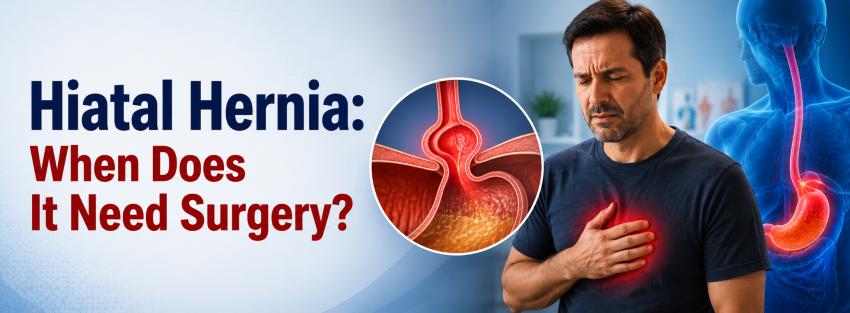
Do you feel constant acidity, chest burning, or a sour taste in your mouth after meals? These signs may point to a hiatal hernia. Many people live with this problem for years without knowing the real cause. A hiatal hernia happens when part of the stomach pushes up into the chest through the diaphragm. This can lead to acid reflux, heartburn, and discomfort after eating.
Not every hiatal hernia needs surgery. Some cases are managed well with medicines and lifestyle changes. But in certain situations, surgery becomes the best and safest option. Knowing when to opt for surgery can save you from long-term complications.
Dr. Jayadatt Pawar is a trusted GI Surgeon with over 15+ years of experience in gastrointestinal and hernia surgeries. He has completed 2,000+ GI surgeries and treated 5,000+ happy patients with a 95% success ratio. As a leading Hernia Specialist in New Delhi, he has helped countless patients get lasting relief from hiatal hernia and related digestive problems.
In this blog, we will explain hiatal hernia in simple words. We will also tell you when surgery is really needed, and why choosing the right surgeon matters.
What Is a Hiatal Hernia?
The diaphragm is a muscle that separates the chest from the abdomen. It has a small opening called the hiatus. The food pipe (oesophagus) passes through this opening to join the stomach.
In a hiatal hernia, part of the stomach slips through this opening into the chest cavity. This weakens the valve that stops acid from flowing back into the food pipe. As a result, patients often suffer from acid reflux and related symptoms.
Common Symptoms of Hiatal Hernia:
Many patients ignore early symptoms, thinking it is normal acidity. Here are common signs to watch for:
- Frequent heartburn, especially after meals or at night
- Acid or sour taste in the mouth
- Chest pain or discomfort
- Difficulty in swallowing food
- Bloating and burping
- Feeling full quickly while eating
- Regurgitation of food or liquid
If these symptoms continue for weeks, it is wise to consult a Hiatal Hernia Specialist in New Delhi for proper diagnosis.
Types of Hiatal Hernia:
There are mainly two types:
- Sliding Hiatal Hernia – The most common type. The stomach and food pipe junction slides up into the chest. It usually causes mild to moderate reflux symptoms.
- Paraesophageal Hiatal Hernia – Less common but more serious. Part of the stomach pushes up beside the food pipe. This type carries a higher risk of complications like twisting or blockage of the stomach.
Knowing the type helps the doctor decide the right treatment plan.
When Can Hiatal Hernia Be Managed Without Surgery?
Not all patients need an operation. In mild cases, doctors first try:
- Antacid or acid-reducing medicines
- Weight management
- Avoiding spicy, oily, and acidic foods
- Eating smaller meals
- Avoiding lying down right after meals
- Quitting smoking and alcohol
These steps work well for many patients with small, sliding hernias. Regular follow-up is still important to monitor the condition.
When Does a Hiatal Hernia Need Surgery?
Surgery becomes necessary in the following situations:
- Severe or Persistent Symptoms: If heartburn keeps coming back even after months of medicines, tablets alone are not enough. It means the valve between the food pipe and stomach has become weak. Surgery fixes this valve and gives lasting relief.
- Large Paraesophageal Hernia: In this type, a big part of the stomach moves up beside the food pipe. It can twist and block its own blood supply. This is an emergency. Doctors advise surgery early to avoid this risk.
- Difficulty Swallowing: If food often gets stuck, or swallowing feels painful, the hernia may be blocking the food pipe. This can also lead to weight loss over time. Surgery corrects this and makes swallowing easy again.
- Bleeding or Anaemia: A trapped part of the stomach can get irritated and bleed slowly. This bleeding is often silent but shows up as low haemoglobin and constant tiredness. Since medicines cannot stop this, surgery is needed.
- Breathing Problems: A large hernia can press on the lungs. This causes breathlessness, especially after meals or while lying down. Surgery removes this pressure and helps you breathe easily.
- Failed Medical Treatment: Doctors usually try medicines first for a few months. If symptoms still do not improve, it means the problem is mechanical, not just acid-related. Surgery then becomes the right and lasting solution.
- Medicines Are Not Working Anymore: Some patients have severe heartburn, regurgitation, or trouble swallowing even after using medicines like proton pump inhibitors regularly. If lifestyle changes and tablets no longer give relief, surgery is the next step.
- Side Effects from Long-Term Medicines: Taking acid-reducing medicines daily for years can sometimes cause side effects that affect your quality of life. If medicines are causing more trouble than good, surgery is a better long-term option.
- Large Size of the Hernia: If the hernia is quite large, often more than 5 to 7 centimetres, or a big part of the stomach has moved into the chest, the risk of complications goes up. In such cases, doctors usually advise surgery even if symptoms are not very severe yet.
How Is Hiatal Hernia Surgery Done?
Modern surgery for hiatal hernia is minimally invasive. This means smaller cuts, less pain, and faster recovery. The two main approaches are:
- Laparoscopic Surgery – Small incisions are made, and a camera guides the surgeon. This method reduces blood loss and hospital stay.
- Robotic Surgery – Offers greater precision, better vision, and more control during complex repairs. It is especially useful for larger hernias.
As one of the leading Robotic Surgeon in New Delhi, Dr. Jayadatt Pawar uses advanced da Vinci robotic technology for precise and safe hiatal hernia repair. Being an accredited da Vinci robotic surgeon, he ensures patients get world-class surgical care with minimal discomfort.
The surgery usually involves pulling the stomach back into place and tightening the diaphragm opening. Often, a procedure called fundoplication is also done. This wraps part of the stomach around the food pipe to strengthen the valve and prevent acid reflux.
Recovery After Surgery:
Recovery after laparoscopic or robotic hiatal hernia surgery is generally smooth. Most patients can:
- Walk within a day of surgery
- Go home in 2 to 3 days
- Return to normal activities within 2 to 3 weeks
- Follow a soft diet for the initial few weeks
Regular follow-up helps track healing and prevents recurrence.
Why Choose Dr. Jayadatt Pawar Hiatal Hernia surgery?
Choosing the right surgeon matters a lot in hernia treatment. Dr. Jayadatt Pawar is recognised as the Best Laparoscopic Surgeon in New Delhi for several reasons:
- 15+ years of experience in GI and hernia surgeries
- 2,000+ successful GI surgeries completed
- 5,000+ happy and satisfied patients
- 95% success ratio in surgical outcomes
- FCRS (Fellowship in Colorectal Surgery) from Hong Kong
- FNB in Laparoscopic and Robotic Surgery from GEM Hospital, Coimbatore
- Accredited da Vinci robotic surgeon
- Guest speaker at international conferences like AAPS Vietnam
- Published 20+ research papers in reputed journals
He currently practices at Amrita Hospital, Faridabad, and Happy Gut Clinic, New Delhi. His patient-centred approach and advanced surgical skills make him a trusted name for hiatal hernia, bariatric, colorectal, and robotic surgeries.
Conclusion:
A hiatal hernia can range from mild to serious. Many patients manage well with medicines and lifestyle changes. But when symptoms become severe, or complications arise, surgery is the safest path forward.
If you are facing constant acid reflux, chest discomfort, or swallowing problems, do not delay consultation. Early diagnosis and timely treatment can prevent bigger health issues later.
Book a consultation with Dr. Jayadatt Pawar, a leading GI Surgeon in New Delhi, and take the first step towards lasting relief.
Contact Details:
📞 8438283406
📧 drjayadattpawar12@gmail.com
Frequently Asked Questions (FAQs):
If you have constant heartburn even after taking medicines, trouble swallowing, chest pain, or low haemoglobin, it may be time for surgery. A proper check-up with a GI Surgeon in New Delhi will confirm if you need an operation.
Watch for worsening acidity, chest pain, breathlessness, food getting stuck often, sudden weight loss, or vomiting. These signs mean the hernia may be growing bigger and needs urgent attention.
There is no fixed size for surgery. Small hernias with mild symptoms are managed with medicines. But if the hernia is large, or more than half the stomach has moved into the chest, doctors usually recommend surgery, even without major symptoms.
A hiatal hernia does not close on its own. Medicines and lifestyle changes only control the symptoms, not the hernia itself. Surgery is the only way to fully repair the weak diaphragm opening.
Most patients go home within 2 to 3 days and return to normal routine in 2 to 3 weeks. Full recovery may take a few weeks longer, depending on the case.
Dr. Jayadatt Pawar is a well-known Hiatal Hernia Specialist in New Delhi, with 15+ years of experience and 2,000+ GI surgeries to his credit. His strong success ratio and advanced training make him a trusted choice for hiatal hernia treatment.