

When facing surgery, the thought of a large cut is often scary. Thankfully, modern medicine uses minimally invasive surgery. This means smaller cuts, less pain, and faster recovery. But what is the difference between the two main types: Laparoscopic and Robotic surgery? Dr. Jayadatt Pawar is here to explain the choices. He is recognized as the best Laparoscopic & Robotic Surgeon in New Delhi and Faridabad. With 15 years of experience, Dr. Pawar has deep knowledge of both techniques. He serves as an Advanced Laparoscopic, Bariatric & Robotic Surgeon at Amrita Hospital at Faridabad, and Elysian Healthcare & Happy Gut Clinic. Dr. Pawar received specialized training in laparoscopy and robotic surgery from the “Father of Laparoscopy,” Dr. C. Palnivelu at GEM Hospital, Coimbatore. He is also proficient in the latest robotic platforms, including the HUGO RAS Robotic systems. Understanding Robotic Surgery vs Laparoscopic Surgery helps you make an informed decision.
What Is Laparoscopic Surgery?
Laparoscopic surgery is often called “keyhole surgery.” It is a type of minimally invasive surgery.
- Meaning of Laparoscopic: The word comes from the laparoscope, which is a long, thin tube with a high-resolution camera and light at the end.
- How it Works: The surgeon makes a few small cuts (usually 5mm to 1cm). Through these cuts, the laparoscope and long, specialized instruments are inserted. The surgeon watches a 2D video screen to perform the operation.
- Benefits of Laparoscopic Surgery: The main laparoscopic surgery benefits include less blood loss, less pain, and a much faster recovery compared to traditional open surgery. Is a laparoscopy safe? Yes, when performed by an experienced surgeon, it is very safe and highly effective.
What Is Robotic Surgery?
Robotic surgery meaning is simple: it is advanced surgery where the surgeon uses a computer console to control robotic arms.
- Robotic Surgery Kya Hoti Hai: The robot itself is a tool. The surgeon—like Dr. Jayadatt Pawar—is always in 100% control. The robotic arms translate the surgeon’s hand movements into precise movements inside the patient’s body.
- Meaning of Robotic Surgery: This technique provides the surgeon with superior vision and greater dexterity than standard laparoscopy. This is why it is often called smart surgery.
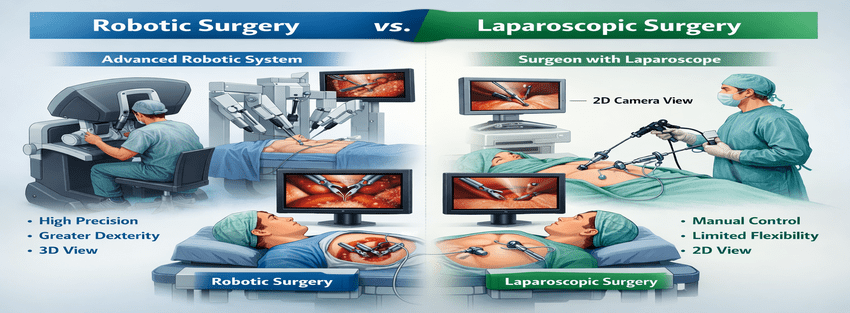
- Robotic Surgery Description: The surgeon sits at a console with a 3D high-definition view and uses hand controls to move the tiny instruments attached to the robotic arms.
Laparoscopic vs Robotic Surgery: Key Differences
The main difference between laparoscopic surgery and robotic surgery is the technology that assists the surgeon. Both methods are minimally invasive, but one offers much greater help to the doctor.
1. Vision Quality:
- Laparoscopy: The surgeon sees a 2-Dimensional (2D) view. This means the image is flat, making it difficult to judge depth or distance inside the body.
- Robotic Surgery: The surgeon sees a highly detailed 3-Dimensional (3D) view. This gives clear depth perception, which is a major advantage for complex procedures.
2. Instrument Movement:
- Laparoscopy: Instruments are straight and stiff. Their movement is restricted and awkward in tight spaces.
- Robotic Surgery: Instruments are “wristed.” They can bend and rotate much more than a human hand. This allows for extremely delicate and precise stitching.
3. Stability and Precision:
- Laparoscopy: Movements are controlled directly by the surgeon’s hand, so any minor tremor is transferred to the instruments.
- Robotic Surgery: The system automatically filters out the surgeon’s natural hand tremor. This results in unmatched stability and pinpoint accuracy during the operation.
4. Surgeon Posture:
- Laparoscopy: The surgeon usually stands beside the patient throughout the operation.
- Robotic Surgery: The surgeon sits comfortably at a console a few feet away, reducing physical fatigue during long, complex surgeries.
Advantages of Laparoscopic Surgery:
Laparoscopic surgery benefits made minimally invasive surgery popular across the globe.
- Cost-Effective: It is generally less expensive than the robotic method.
- Proven Safety: This method has been used for decades and is considered very safe for many common operations. Is laparoscopy safe? Yes, it is the standard of care for many procedures.
- Quick Recovery: Patients still benefit from small incisions, leading to a fast return to work.
Advantages of Robotic Surgery:
The advantage of robotic surgery lies in its ability to perform highly complex operations with unmatched precision.
- Superior 3D Vision: The surgeon gets a magnified, high-definition, 3D view. This is a huge benefit for difficult surgeries.
- Greater Dexterity: The robotic instruments have “wrists” that can move in ways a human hand cannot in a restricted space. This allows for extremely fine stitching and dissection (robotic surgery pros).
- Enhanced Precision: The system automatically stabilizes the instruments, eliminating any human tremor. This makes the robotic surgery vs laparoscopic surgery comparison clear for complex cases.
- Surgeon Comfort: The surgeon is seated, leading to less physical fatigue during long, intricate procedures. This contributes to better outcomes. What are the advantages of robotic surgery? Better precision and vision are the main ones.
Disadvantages of Laparoscopic and Robotic Surgery:
No technology is perfect. There are some downsides to consider in Robotic Surgery vs Laparoscopic Surgery.
Disadvantages of Laparoscopic Surgery:
- Limited Motion: The instruments are straight sticks, limiting the angles the surgeon can work at, especially in tight areas.
- 2D View: Operating with a flat image makes judging depth difficult, increasing the surgical learning curve.
Disadvantages of Robotic Surgery:
- Cost: The machines are expensive to buy and maintain. This results in a higher overall surgical cost for the patient (robotic surgery cons).
- Setup Time: Setting up the robot can take longer than setting up laparoscopic instruments.
- No Haptics (Sense of Touch): The surgeon cannot directly “feel” the tissues through the robotic controls, relying entirely on visual feedback.
Endoscopic vs Laparoscopic vs Robotic Surgery:
It is important to understand the difference between three terms often used in minimal access surgery. The endoscopic versus laparoscopic difference is key.
- Endoscopic Surgery: This involves passing a flexible tube (endoscope) through a natural opening (mouth or anus) to treat conditions inside the organs (like removing polyps from the colon). The endoscopy laparoscopy difference is simple: Endoscopy is inside the organ; Laparoscopy is inside the abdomen.
- Laparoscopic Surgery: Uses small cuts in the abdomen to access the abdominal cavity.
- Robotic Surgery: A highly advanced form of laparoscopic surgery, using the robotic system through small cuts in the abdomen.
How Dr. Jayadatt Pawar Chooses the Right Surgical Approach:
Dr. Jayadatt Pawar, a highly skilled Laparoscopic and Robotic Surgeon in New Delhi, does not believe in a one-size-fits-all approach. He selects the right technique based on the patient’s specific need.
- Laparoscopy: Used for routine procedures like gallbladder removal, simple hernia repair, and appendectomy. The laparoscopic surgery benefits are perfectly suited here.
- Robotic Surgery: Used for highly complex operations like advanced cancer surgery (colorectal, upper GI), bariatric surgery, and complex hernia re-do operations. For these cases, the precision of Robotic Surgery vs Laparoscopic Surgery is the best choice.
Which Surgery Is Better?
The question isn’t which technique is absolutely better, but which is better for your condition. Both techniques are highly effective in reducing pain and speeding recovery compared to traditional open surgery.
For a common surgery, the benefits might be similar, but the difference between laparoscopic surgery and robotic surgery becomes huge when dealing with complex cancer cases deep inside the body. In these complex scenarios, the 3D vision and wristed instruments of the robot provide the surgeon with an undeniable advantage. Choosing Dr. Pawar means you have access to both technologies and the expertise to know which one will deliver the best outcome.
Conclusion:
Understanding Robotic Surgery vs Laparoscopic Surgery gives you confidence in your treatment plan. Both are excellent options for minimally invasive procedures. Dr. Jayadatt Pawar, the best Laparoscopic & Robotic Surgeon in New Delhi, uses his training and experience in both standard laparoscopic and robotic surgery to customize your care.
If you are facing an operation and want to discuss which minimally invasive option is right for you.
contact: Dr. Jayadatt Pawar at Amrita Hospital or Happy Gut Clinic today.