

Hernia is a common condition in which an organ or tissue pushes through a weak area in the abdominal wall. It may appear as a swelling or bulge in the abdomen or groin and can cause pain or discomfort.
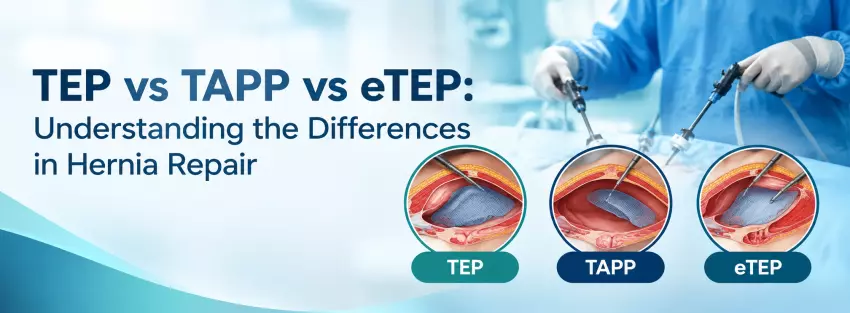
TEP, TAPP and eTEP are minimally invasive techniques used for selected types of hernia repair. Each technique uses a different surgical approach and may be suitable for different hernia locations and conditions.
In this article, Dr. Jayadatt Pawar,Hernia Specialist, explains the difference between TEP vs TAPP vs eTEP, the types of hernia they can treat, their benefits and limitations, and the factors that help in choosing a suitable repair technique.
What Are TEP, TAPP and eTEP Hernia Repair Techniques?
A hernia happens when a part of your gut or fat pushes out through a weak spot in the belly wall. You see it as a bulge. It does not go away on its own. Surgery is the only permanent treatment.
TEP, TAPP and eTEP are three types of laparoscopic hernia surgery. This is also called minimally invasive hernia surgery. The surgeon makes very small cuts. A thin camera shows the inside of your body on a screen. Fine instruments are used to do the repair.
In all three methods, the weak spot is repaired. Then a mesh is placed to make it strong. This is called laparoscopic mesh repair. The only difference is the route the surgeon takes to reach the hernia.
TEP Hernia Repair: What Is It and How Is It Done?
What Is TEP?
TEP is a laparoscopic or endoscopic hernia repair technique in which the surgeon reaches the hernia through the extraperitoneal space.
The abdominal cavity itself is not routinely entered.
How Does TEP Surgery Work?
Small incisions are made to introduce a camera and surgical instruments. A working space is created outside the peritoneal cavity.
The hernia is identified and reduced. A mesh is then positioned in the preperitoneal space to reinforce the weak area.
This is why TEP is also described as a preperitoneal hernia repair technique.
Benefits of TEP Repair:
TEP can provide:
- A minimally invasive approach
- Access to the groin from behind the abdominal wall
- The possibility of treating bilateral inguinal hernias
- Mesh placement over the relevant groin defect
- Avoidance of routine entry into the abdominal cavity
Limitations of TEP Repair:
TEP can be technically demanding. Previous lower abdominal or pelvic surgery may make the extraperitoneal space difficult to develop.
The suitability of TEP also depends on the anatomy of the hernia and the surgeon’s experience with the technique.
TAPP Hernia Repair: What Is It and How Is It Done?
What Is TAPP?
TAPP stands for Transabdominal Preperitoneal repair. Unlike TEP, TAPP involves entering the abdominal cavity to reach the preperitoneal plane.
How Does TAPP Surgery Work?
A laparoscope and instruments are introduced through small abdominal incisions.
The surgeon enters the abdominal cavity and identifies the hernia and surrounding anatomy. The peritoneum is opened to reach the preperitoneal space.
After the hernia is reduced, mesh is placed to cover the relevant hernia defects. The peritoneum is then closed over the mesh.
Benefits of TAPP Repair:
One important feature of TAPP is the wide view of the abdominal cavity and groin anatomy.
This can be useful when assessing both sides of the groin. During TAPP, the opposite side can also be inspected for an occult hernia when clinically appropriate.
Limitations of TAPP Repair:
Because TAPP involves entering the abdominal cavity, it has considerations related to intra-abdominal access.
The technique may not be suitable for every patient. Previous operations, adhesions and other patient-specific factors can influence the surgical approach.
eTEP Hernia Repair: How Is It Different?
What Is eTEP?
eTEP is an extended Totally Extraperitoneal technique. It builds on the principles of TEP but creates a larger extraperitoneal working space.
How Does eTEP Work?
Instead of entering the abdominal cavity, the surgeon develops an extended space between the abdominal wall layers.
This can provide access to a larger area for hernia mesh placement. Depending on the hernia, eTEP can be used as part of minimally invasive abdominal wall surgery.
Benefits of eTEP
The extended working space may allow surgeons to address selected:
- Ventral hernias
- Incisional hernias
- Larger abdominal wall defects
- Complex abdominal wall hernias
- Selected cases requiring abdominal wall reconstruction
The use of eTEP is an evolving area of hernia surgery, and case selection remains important. Recent Indian multicentre research has specifically examined eTEP alongside TEP and TAPP for groin hernia repair.
TEP vs TAPP vs eTEP: Key Differences
The main difference is where the surgeon works and how the hernia is approached.
TEP works outside the abdominal cavity. TAPP enters the abdominal cavity before reaching the preperitoneal plane. eTEP extends the extraperitoneal approach to create wider access.
Therefore, TEP vs TAPP which is better cannot be answered with one technique for every patient.
TEP vs TAPP vs eTEP – Comparison of Surgical Techniques:
Recent evidence comparing TEP and TAPP suggests broadly similar early recovery outcomes, while some complication profiles may differ. This supports the principle that the choice should be individualised rather than based on one technique being universally superior.
Which Hernia Types Can Be Treated With TEP, TAPP or eTEP?
TEP and TAPP are primarily associated with inguinal hernia repair. They may be considered for unilateral and bilateral inguinal hernia in suitable patients.
They may also have a role in selected recurrent inguinal hernia cases, depending on the previous repair and current anatomy. Femoral hernia can also be treated with a laparoscopic preperitoneal approach such as TEP or TAPP in selected patients.
eTEP provides an extended extraperitoneal approach and may be considered for selected:
- Ventral hernia repair
- Umbilical and para-umbilical hernia repair
- Incisional hernia repair
- Complex abdominal wall hernia
- Larger abdominal wall defects
- Abdominal wall reconstruction
The exact technique depends on the location, size and characteristics of the hernia, previous abdominal surgery, recurrence and the patient’s overall condition. Not every hernia is suitable for TEP, TAPP or eTEP. In some cases, another open, laparoscopic or robotic approach may be more appropriate.
Factors That Influence the Choice of Hernia Repair:
- Hernia Location and Size: The location and size of the hernia are important factors when choosing a repair technique. An inguinal hernia in the groin may be treated differently from a ventral or incisional hernia in the abdominal wall. A larger or more complex hernia may require a wider surgical approach and different mesh placement.
- Previous Abdominal Surgery: Previous abdominal surgery can cause scar tissue and change the normal tissue planes inside the abdomen. This can make some surgical approaches more difficult. The surgeon considers the location and type of previous surgery before deciding whether TEP, TAPP or eTEP is suitable.
- Recurrent Hernia: A recurrent hernia is a hernia that develops again after an earlier repair. In such cases, the surgeon needs to understand the previous repair, including the surgical approach and mesh placement. A different tissue plane may sometimes be considered to avoid operating through heavily scarred tissue.
- Patient’s Overall Health: The patient’s overall health is also considered before choosing a hernia repair technique. Age, body weight, other medical conditions, previous surgeries and general fitness can affect surgical planning. The surgeon also considers whether the patient can safely undergo anaesthesia and how the patient is likely to recover after surgery.
- Surgeon’s Experience and Expertise: TEP, TAPP and eTEP are technically different procedures and require knowledge of the anatomy of the abdominal wall and groin. The surgeon’s training and experience with a particular technique are important factors in surgical planning. Correct identification of the hernia, careful dissection and proper hernia mesh placement are important for a safe and effective repair.
Recovery After TEP, TAPP and eTEP Hernia Surgery:
Hernia surgery recovery time is short after laparoscopic repair. Here is what you can expect:
- Most patients go home the same day or the next day
- You can start walking from day one
- Many people go back to office work in about one week
- Heavy lifting should be avoided for 4 to 6 weeks
- Larger repairs, like eTEP, may need a little more time
For good hernia surgery recovery, follow these simple tips:
- Eat fibre-rich food like fruits, vegetables and dal
- Drink enough water
- Avoid straining during motion
- Do not lift heavy weights early
- Come for follow-up visits on time
Risks and Possible Complications:
Like other surgical procedures, laparoscopic mesh repair has potential risks.
These may include:
- Pain
- Bruising or swelling
- Seroma
- Bleeding
- Infection
- Urinary problems
- Recurrence
- Mesh-related complications
- Injury to nearby structures
The risk depends on the type of hernia, patient factors and surgical technique.
When Should You See a Hernia Specialist?
You should consult a hernia specialist if you have:
- A swelling or bulge in the abdomen or groin.
- Pain or discomfort while coughing, walking or lifting.
- A hernia that is increasing in size.
- Difficulty doing daily activities because of the hernia.
- A recurrent or previously operated hernia.
- A bilateral, large or complex hernia.
Seek urgent medical care if the swelling becomes very painful, hard, tender or cannot be pushed back, especially with vomiting, abdominal swelling or difficulty passing stool or gas.
A specialist can examine the hernia and explain whether observation or surgery is needed and which repair technique may be suitable.
Conclusion:
TEP, TAPP and eTEP have made minimally invasive hernia repair possible for many suitable patients. However, there is no single technique that is right for every hernia. The choice depends on the type, size and location of the hernia, previous surgery, recurrence and the patient’s overall health.
Understanding these differences can help patients have a better discussion with their surgeon and make an informed treatment decision. The right technique is the one that safely addresses the individual hernia and its specific requirements.
If you have a hernia, do not ignore a growing swelling, repeated pain or discomfort. Book a consultation with Dr. Jayadatt Pawar for a detailed evaluation of your hernia and to understand which treatment and repair approach may be suitable for you.
Frequently Asked Questions About TEP, TAPP and eTEP:
TEP repairs the hernia through the extraperitoneal space without routinely entering the abdominal cavity. TAPP enters the abdominal cavity first and then reaches the preperitoneal space. Both techniques can be used for selected inguinal hernias.
Both TEP and TAPP are established techniques for suitable inguinal hernias. There is no single option that is better for every patient. The choice depends on the hernia, previous surgery, patient anatomy and the surgeon’s experience.
eTEP stands for extended Totally Extraperitoneal repair. It creates a larger working space outside the abdominal cavity and allows the surgeon to access a wider area of the abdominal wall. It may be considered for selected groin, ventral and incisional hernias.
TEP works in the extraperitoneal space, while TAPP enters the abdominal cavity before reaching the preperitoneal space. eTEP is an extended extraperitoneal approach that provides a larger working area for selected hernias.
There is no single best laparoscopic hernia repair technique for all patients. The appropriate method depends on the type, location and size of the hernia, previous surgery and the patient’s overall health. Surgical expertise is also an important factor.
Both TEP and TAPP can be used for suitable bilateral inguinal hernia cases. The surgeon may choose either approach based on the patient’s anatomy, previous operations and the characteristics of both hernias.
Recovery after laparoscopic hernia surgery varies from person to person. Many patients gradually return to routine activities, but hernia surgery recovery time depends on the type and size of the hernia, surgical technique and individual healing.
Possible complications include pain, swelling, bleeding, infection, seroma, urinary problems, hernia recurrence and mesh-related complications. The risk varies according to the patient’s condition and the type of repair performed.