

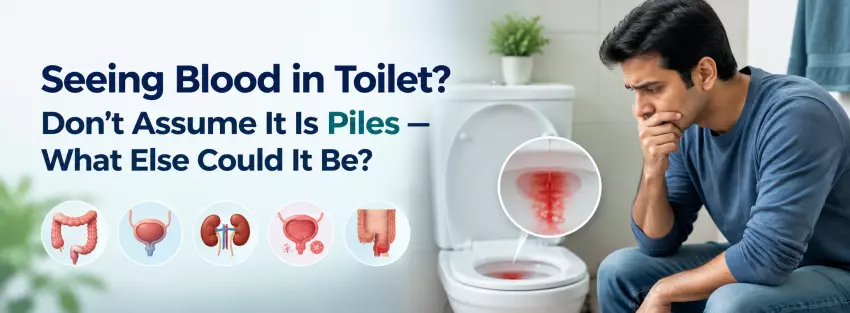
Seeing blood in the toilet can scare anyone. Most people think, “It must be piles.” Many feel shy and do not go to a doctor.
Piles are a common reason. But they are not the only reason. Sometimes, blood in stool shows a serious problem in the colon or rectum.
Many people search for a piles specialist as soon as they see blood. But first, it is important to know whether the problem is really piles. In this blog, Dr. Jayadatt Pawar is a Robotic and Laparoscopic Surgeon. He has 15+ years of experience. He explains the other possible causes, the warning signs to watch for, and when you should get a check-up.
What Does Blood in the Toilet Mean?
Blood in the toilet means there is bleeding somewhere in your food passage. It can come from the anus, rectum, colon, stomach or food pipe.
The blood may be a small streak or a large amount. There may be pain, or there may be none. In both cases, please get it checked.
What Does the Colour of Blood in Stool Tell You?
The colour of blood gives a clue about where the bleeding is coming from. It does not give the final answer. But it helps the doctor a lot.
Bright Red Blood After Passing Stool:
Bright red blood mostly comes from the lower part of the gut. This means the anus or rectum.
You may see blood on toilet paper after a bowel movement. You may also see drops in the toilet pot. Piles and fissures are common reasons. Polyps and growths in the rectum can also cause it.
Many people ask about bright red blood in stool without pain. Piles often bleed without pain. But polyps and cancer can also bleed without pain. So, never ignore painless bleeding.
Dark Red or Maroon Blood in Stool:
Dark red blood in stool usually comes from higher up. It may come from the colon or the last part of the small intestine. Diverticular disease, colitis and growths in the colon can cause this. A scope test is often needed.
Black, Tarry Stool: Could It Be Internal Bleeding?
Yes, it could be. Black stool causes include bleeding from the stomach or upper gut. The stool looks black and sticky. It also smells very bad.
Common reasons are stomach ulcers, gastritis and swollen veins in the food pipe. Iron tablets and some foods can also make stool dark. But if the stool is tarry, see a doctor the same day.
7 Possible Causes of Blood in Stool Other Than Piles:
Piles are not the only reason for bleeding while passing stool. Here are seven other causes that doctors commonly see.
- Anal fissure: This is a small tear in the skin around the anus. It usually causes sharp pain during stool, along with a little fresh blood.
- Colon polyps: These are small growths inside the colon. Most polyps cause no trouble at first. But some can slowly turn into cancer over the years, so doctors prefer to remove them early.
- Colitis: Here, the inner lining of the colon becomes swollen and sore. It can happen due to an infection or ulcerative colitis. You may notice loose motions, cramps and blood in stool.
- Inflammatory bowel disease (IBD): This includes Crohn’s disease and ulcerative colitis. It is a long-term condition and needs regular treatment and follow-up.
- Diverticular disease: In this condition, small pouches form in the wall of the colon. Sometimes one of these pouches bleeds suddenly, often without much pain.
- Colorectal cancer: This is a growth in the colon or rectum. In the early stage, the only sign may be mild bleeding. That is why bleeding should never be ignored.
- Rectal ulcer or infection: Sores or infection inside the rectum can cause blood along with mucus in the stool.
Here is a quick comparison.
How to Know If Blood in Stool Is Due to Piles or Something More Serious?
You cannot be sure just by looking at the blood. But some clues can help. Piles usually cause painless, bright red bleeding. You may feel a soft lump near the anus. Weight loss is rare.
Now let us see the difference between piles and anal fissure. A fissure gives sharp, burning pain during and after stool. The blood is a thin streak. Piles are usually painless, unless they are swollen or have a clot.
Anal fissure symptoms and bleeding also include fear of passing stool and tight, painful spasms.
Something more serious may be there if you notice:
- Mucus and blood in stool
- Change in bowel habits for a long time
- Bleeding that keeps coming back even after treatment
Warning Signs You Should Never Ignore:
Please see a doctor soon if you have blood in stool along with any of these:
- Blood in stool with unexplained weight loss
- Constant tiredness or pale look (may be anaemia)
- Stomach pain or cramps that do not go away
- Thin, pencil-like stools
- Feeling that the stomach does not clear fully
- Black, tarry stools
- Fever, vomiting or dizziness
- Family history of colon or rectal cancer
Can Blood in Stool Be a Sign of Colon or Rectal Cancer?
Yes, it can be. But it does not mean you have cancer. Most cases are due to simple problems.
Still, the early signs of colorectal cancer are easy to miss. They include blood in stool, change in bowel habits, weight loss and tiredness. Cancer can also cause painless rectal bleeding. People often blame it on piles.
Colon and rectal cancer can be treated well if found early. That is why tests matter. A quick check today can save you from big trouble later.
When Should You See a Doctor for Blood in Stool?
Here is when to see a doctor for blood in stool. Do not wait if:
- Bleeding lasts more than a few days
- Bleeding comes again and again
- You are above 40 years of age
- You have any warning sign from the list above
- You pass a lot of blood or feel faint
Go to the emergency room at once if there is heavy bleeding. Also go if you have black stools with weakness.
How Do Doctors Find the Cause of Rectal Bleeding?
First, the doctor asks about your symptoms, food habits and family history. Then the doctor gently examines the anal area.
After that, these tests may be advised:
- Blood tests to check for anaemia
- Stool tests to look for infection or hidden blood
- Proctoscopy or sigmoidoscopy to see the anus and lower rectum
- Colonoscopy for rectal bleeding: A thin tube with a camera checks the whole colon. Polyps can also be removed during this test.
- Scans like CT scan or MRI, if needed
These tests are safe when done by an expert. Colonoscopy is the best test to find colon problems.
What Is the Treatment for Blood in Stool?
The treatment depends on what is causing the bleeding. There is no single medicine that works for every case. Once the cause is clear, the doctor can plan the right treatment.
- Piles: Many people get relief with changes in diet, more water and fibre, and medicines. If the piles are large or keep coming back, a minimally invasive procedure may be advised.
- Anal fissure: Most fissures heal with ointments and stool softeners. If the pain and bleeding continue, a small procedure may be needed.
- Polyps: These are usually removed during colonoscopy itself, so there is no need for open surgery.
- Colitis and IBD: These are long-term conditions. They are managed with regular medicines and follow-up visits.
- Diverticular disease: Mild cases settle with diet changes and medicines. Surgery is needed only in severe cases.
- Colorectal cancer: Surgery is the main treatment. It is often done by laparoscopic or robotic methods. Some patients may also need other treatment, depending on the stage.
Laparoscopic and robotic surgery use very small cuts instead of one big cut. Because of this, most patients have less pain, a shorter hospital stay and a faster recovery. Dr. Jayadatt Pawar, an accredited da Vinci robotic surgeon, often uses these methods for suitable cases.
Frequently Asked Questions (FAQ's) About Blood in Stool:
No, not always. Piles are a common cause, but anal fissures, colon polyps, colitis, diverticular disease and colorectal cancer can also cause blood in stool. That is why the cause should be confirmed by a doctor and not guessed.
Piles are the most common reason for bright red blood in stool without pain. But polyps and growths in the rectum can also cause painless rectal bleeding. A proper check-up is the only way to be sure.
The main difference is pain. Piles usually bleed without pain, and you may feel a soft lump near the anus. An anal fissure causes sharp, burning pain during and after stool, with a thin streak of bright red blood.
Yes, it can be. But most cases are due to simple problems like piles or fissures. The chance of colon cancer is higher if the bleeding comes with weight loss, constant tiredness or a long-term change in bowel habits.
You should worry if the bleeding lasts more than a few days or keeps coming back. Also see a doctor if you have weight loss, stomach pain, weakness, anaemia or black, tarry stool. Heavy bleeding needs emergency care.
Yes. Hard stool can tear the skin around the anus or irritate piles, which causes blood in stool with constipation. It is quite common. But if the bleeding repeats, please get it checked.
The doctor may advise blood tests, stool tests, proctoscopy, colonoscopy or scans like CT and MRI. Colonoscopy is the most useful test to look inside the colon. The doctor will choose the tests based on your symptoms.
A colorectal surgeon or a GI surgeon is a good choice, as they treat problems of the colon, rectum and anus. A gastroenterologist can also help with diagnosis. If surgery is needed, choose a doctor with proper training and experience in this area.
Conclusion: Do Not Ignore Blood in Stool Find the Cause Early
Blood in stool is a symptom, not a disease. Piles are common, but they are not the only reason. Guessing can delay treatment of serious problems.
Please do not feel shy. Early diagnosis makes treatment simple and recovery fast.
Dr. Jayadatt Pawar holds MBBS, MS (General Surgery), DNB, FMAS, FNB (Laparoscopic & Robotic Surgery) and FALS (Bariatric Surgery). He has also completed a Fellowship in Colorectal Surgery (FCRS) in Hong Kong. He has published 20+ research papers. He is a member of AMASI, IAGES and ACRSI. He is also an international faculty speaker. His patients trust his careful, patient-first approach.
Book your consultation today.